How to Make an App Like TikTok: Architecture to MVP
How to make an app like TikTok: the video pipeline, feed ranking, moderation and real costs, plus prompts to build a short-video MVP with AI today.

By Supacode Editorial · Product and engineering
Contents
Quick answer
To make an app like TikTok you need five systems: video upload, transcoding into streamable formats, delivery through a CDN, a feed that ranks clips by what each viewer watches, and moderation. Build the feed experience first as a prototype with sample videos (Supacode's Looply template does this in minutes), test it with real people in a niche, then add the video pipeline and moderation through managed services before a public launch.
- The interface is the easy part to copy. Audience, recommendations and moderation are the hard parts.
- Use managed video services for transcoding and delivery; delivery minutes dominate the bill as you grow.
- Start in a niche (home cooks, climbers, language learners) where a small audience can still feel alive.
- Moderation, reporting and blocking are required before a public launch, by app stores and, in many places, by law.
Why is TikTok so hard to copy, and what can you copy?
Open TikTok and the first video is already playing. No menu, no search, no choice. Swipe, and the next one is there before your thumb leaves the glass. That frictionless loop is the product, and it is why every social app since has grown a vertical video tab.
The loop looks simple because enormous machinery is hidden behind it. TikTok explains in its own newsroom that the For You feed is shaped by user interactions, video information, and device and account settings, learned from what you watch, skip, like and share. That system has been trained on an audience of a size no startup will have on day one.
So separate what you can copy from what you can't:
| Part of TikTok | Can a small team build it? | How |
|---|---|---|
| Full-screen vertical feed, swipe, like, comment, share | Yes, in days | Ordinary front-end code; an AI builder writes it in minutes |
| Upload, transcode and stream video | Yes | Managed services (Cloudflare Stream, Mux, cloud media pipelines) |
| Moderation and reporting | Yes, and you must | Automated scanning plus a human review queue |
| A recommendation engine trained on vast audiences | Not at first | Start with follows, recency and popularity; learn from your own signals |
| Music catalogue licensing | Rarely | Original audio only, or a licensed library |
The opening for a new app is a niche. A short-video app for home cooks, climbers or language learners doesn't need a billion users to feel alive; it needs a few hundred people who care about the same thing.
What is the architecture of a TikTok-style app?
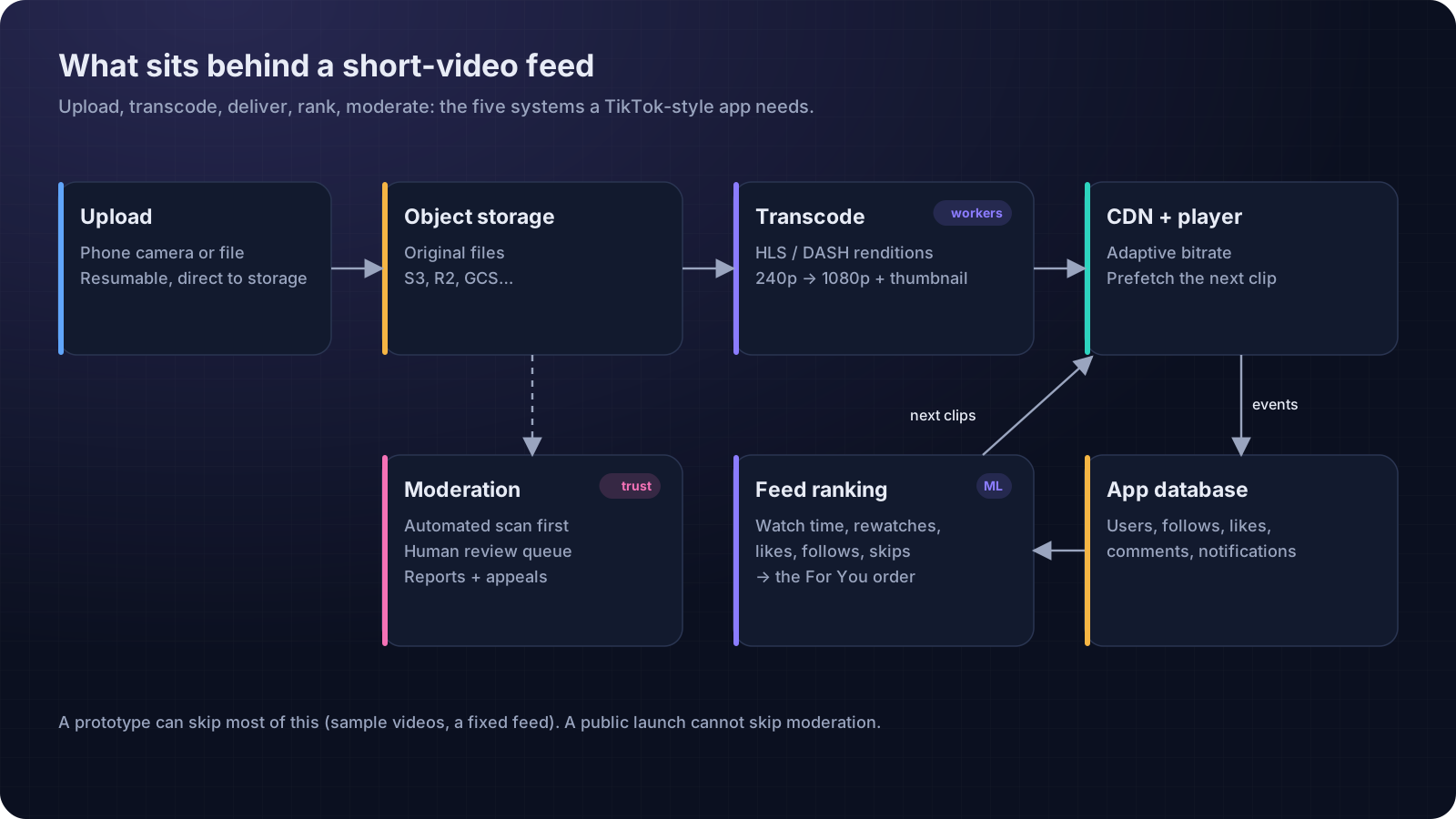
- Upload. Phones produce large files on flaky connections, so uploads should be resumable and go straight from the device to storage with a short-lived signed URL, never through your app server.
- Transcoding. One upload becomes several versions at different resolutions and bitrates, packaged for adaptive streaming with formats such as Apple's HTTP Live Streaming (HLS), plus a thumbnail. This is heavy compute; rent it.
- Delivery. A CDN serves the segments close to viewers, and the player switches quality as the connection changes. Good players also prefetch the next clip, which is the trick behind the instant swipe.
- Feed and ranking. Start simple: videos from people you follow, then popular and recent clips in your niche. Record watch time, rewatches, likes and skips from day one; that data is what a smarter ranking will learn from later.
- Moderation. Every upload is scanned automatically before or shortly after it goes public, users can report anything, and a human queue resolves reports and appeals.
Around these sit the ordinary parts of a social app (profiles, follows, comments, notifications) in a relational database such as Postgres, with files in object storage like Supabase Storage or Cloudflare R2.
How much does it cost to run a short-video app?
Video is the most expensive kind of content to serve, and the bill is driven by minutes watched, not minutes uploaded. Here is a worked example using Cloudflare Stream's published pricing as of November 2026: $5 per month for each 1,000 minutes stored, and $1 per 1,000 minutes delivered.
| Stage | Library stored | Minutes watched a month | Storage | Delivery | Total a month |
|---|---|---|---|---|---|
| Friends and family beta | 500 minutes | 30,000 | ≈ $5 | ≈ $30 | ≈ $35 |
| Niche community: 1,000 daily viewers, 15 min/day | 5,000 minutes | 450,000 | ≈ $25 | ≈ $450 | ≈ $475 |
| Growing app: 10,000 daily viewers, 20 min/day | 50,000 minutes | 6,000,000 | ≈ $250 | ≈ $6,000 | ≈ $6,250 |
Delivery dominates, which is why engagement is both your best metric and your biggest cost. Other providers price differently: Mux, for example, bundles a monthly allowance of delivery minutes into its plans, and Cloudflare R2 charges for storage with no egress fees if you run your own pipeline. Price your expected watch time against two or three providers before you commit.
The rest of the stack (database, sign-in, app hosting) is small by comparison until you are large. Moderation is the cost founders forget: automated scanning is billed per item, and human review is people's time.
How do you make a TikTok-style MVP step by step?
The goal of an MVP is to learn whether people in your niche will watch and post, not to rebuild TikTok's infrastructure. Supacode gets you a working, shareable feed in minutes, so you can spend your time on that question.
Step 1: Start from the Looply template
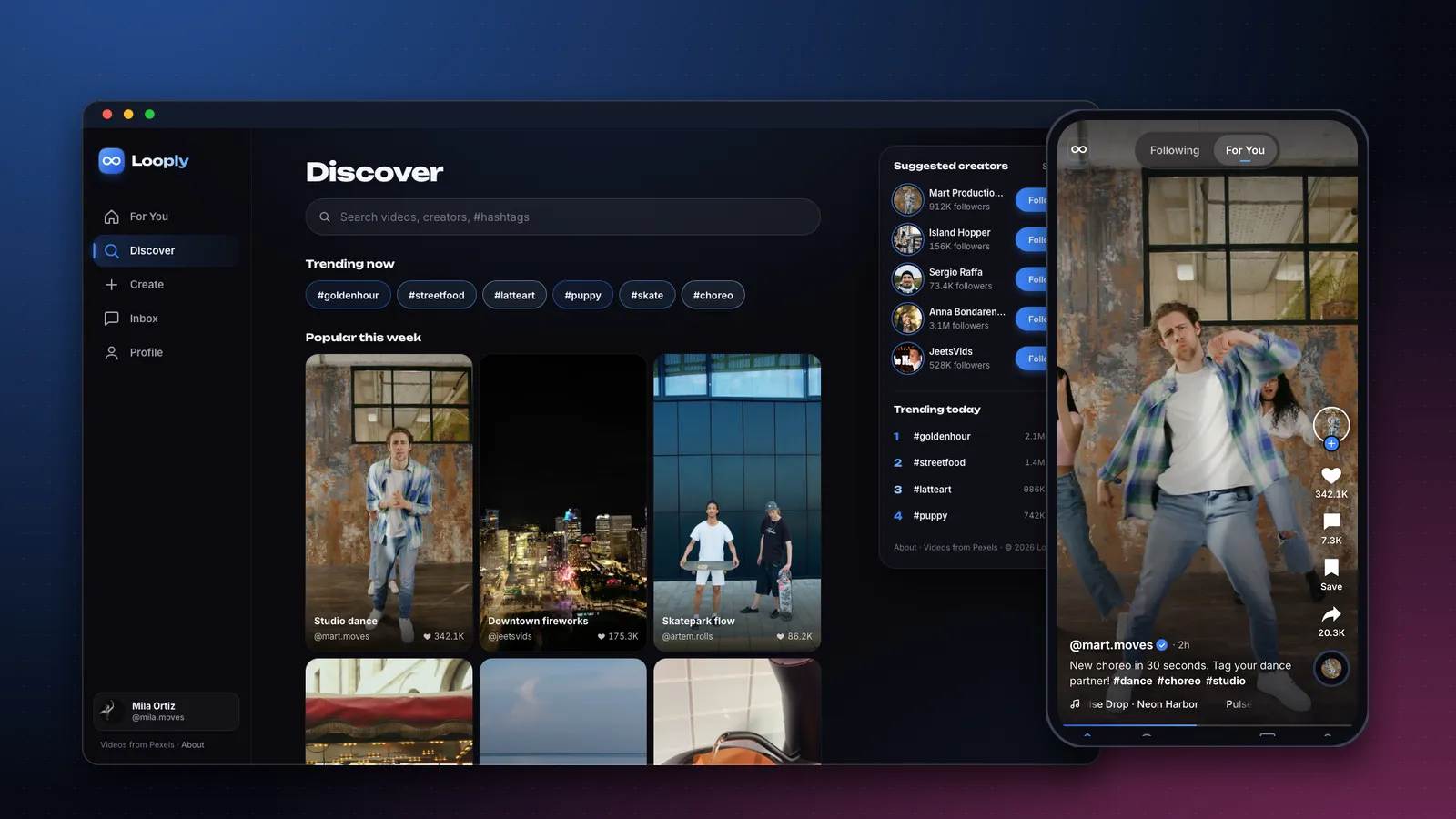
Open Looply and press Use this template. Copying is free (0 credits). Its accounts, counts and comments are sample data, and its videos come from Pexels, so you can show it to people immediately.
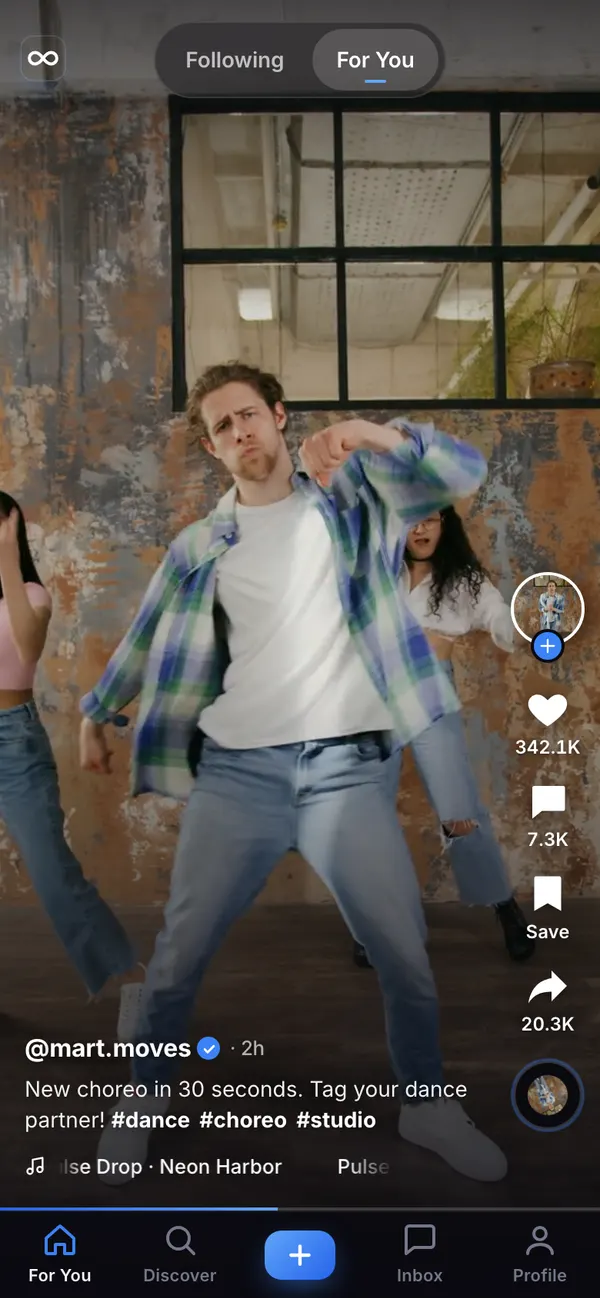
Step 2: Make it about your niche
Rebrand by chatting. Or, if you'd rather start fresh, describe the whole app in one prompt:
Build a short-video app called Clipnest for home cooks. A full-screen vertical feed that snaps one video at a time, with like, comment, save and share on the right, a Discover page with hashtags, a creator profile grid, and an upload screen. Use sample videos and data.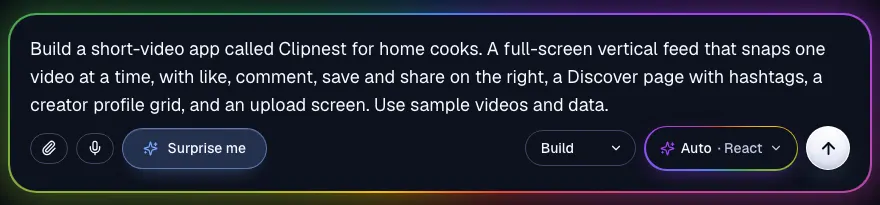
Step 3: Get the feel right
Make swiping feel instant: preload the next two videos, start playback muted with a tap-to-unmute hint, pause when the video leaves the screen, and show a thin progress bar. Support arrow keys on desktop. Respect reduced motion for the like animation.Step 4: Shape the creation flow
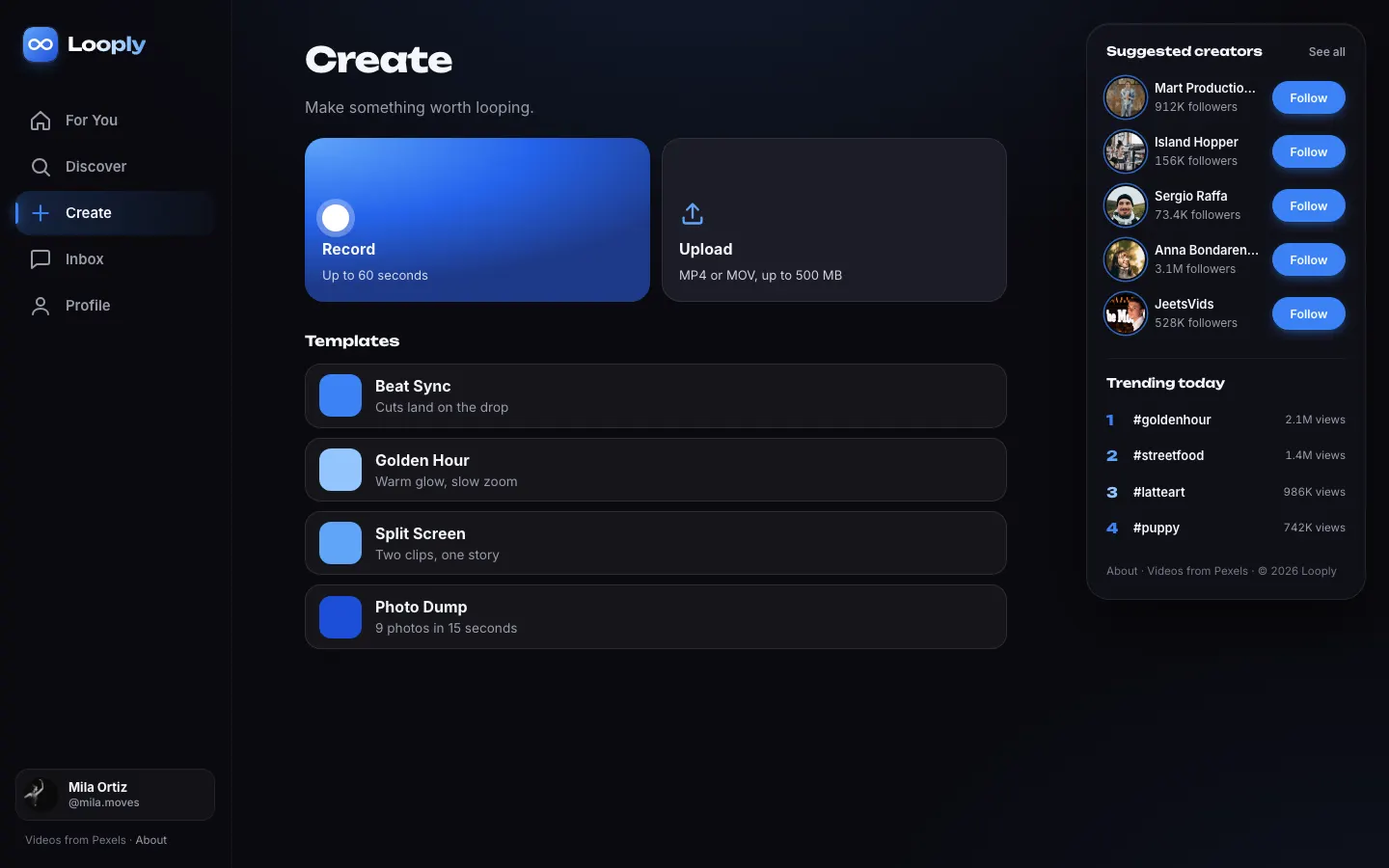
Redesign the Create screen for recipes: Upload a clip (MP4 or MOV), then a form with dish name, cooking time, up to three hashtags and an optional ingredients list that appears as a card over the video. Keep it a demo for now: show a preview and a 'Posted' state without uploading anything.Step 5: Publish and test with real people
Publish to your supacode.app address, share the link with twenty people in your niche, and watch what they do. Do they swipe past the first clip? Do they open Discover? Would they post? Each answer changes what you build next. Every change you make is a restorable version (guide).
Step 6: Add real uploads and accounts
When the feedback says build it, move to real infrastructure. Create the production version as a Next.js project, connect your own Supabase in the Backend tab, and ask:
Add Supabase Auth and tables for profiles, videos, follows, likes and comments with row-level security. For uploads, add a route handler that requests a direct upload URL from Cloudflare Stream (key in process.env.CF_STREAM_TOKEN), save the video id in Supabase, and play videos with the HLS URL. New videos start as 'pending review' and are hidden from the feed until approved.A project with server routes publishes through Deploy to my Vercel, into your own Vercel account, where you add the keys as environment variables. Supacode writes the database changes as a migration that runs only after you approve it (guide).
What do you need for moderation, safety and the law?
- Automated first pass. Scan uploads for nudity, violence and known illegal material before they reach the feed.
- Reports and a human queue. Every post and comment needs a Report button, and someone has to look at the queue every day.
- Legal duties. In the United States, providers must report apparent child sexual abuse material to NCMEC's CyberTipline under 18 U.S.C. § 2258A. In the EU, the Digital Services Act sets notice-and-action and transparency obligations for online platforms. Take legal advice before a public launch.
- Copyright. Music is TikTok's licensed advantage. Stick to original audio or a properly licensed library.
- Young users. Decide on a minimum age, ask for it at sign-up, and design defaults (private accounts, limited messaging) accordingly.
How long does it take to make an app like TikTok?
| Milestone | With Supacode and managed services | Typical custom build |
|---|---|---|
| Clickable prototype with sample videos | Under an hour | One to two weeks |
| Private beta: real accounts, uploads, simple feed | One to three weeks | Two to three months |
| Public launch: moderation, reporting, analytics, store apps | Two to four months | Six months or more |
The prototype is no longer the bottleneck. The work that remains (moderation, trust, finding an audience) is the part that decides whether a social app succeeds.
FAQ
Frequently asked questions
How much does it cost to make an app like TikTok?
A prototype can cost nothing on Supacode's Free plan. Running costs are driven by minutes watched: at Cloudflare Stream's November 2026 prices, 10,000 daily viewers watching 20 minutes a day is about $6,000 a month in delivery alone, before moderation, storage and hosting.
Can I build a TikTok clone without coding?
You can build and publish a working short-video prototype without coding, for example from Supacode's Looply template. Real uploads, transcoding and moderation need managed services and server code, which Supacode can write for you in Next.js to deploy to your own Vercel.
Does the Looply template stream real user uploads?
No. Looply plays sample videos from Pexels with sample accounts and counts, and its Record and Upload screens are demos. It is a front end you can rebrand and test before adding a real video pipeline.
What technology does a TikTok-style app use?
Resumable uploads to object storage, a transcoder that produces adaptive streaming formats such as HLS, a CDN and video player, a relational database for social data, a ranking service for the feed, and a moderation system.
How does TikTok's algorithm work?
TikTok says its For You feed is shaped by user interactions such as likes, comments and follows, by video information such as captions and sounds, and by device and account settings. A new app should start with follows, recency and popularity and collect the same kinds of signals.
Do I need moderation for a small social app?
Yes. App stores require filtering, reporting and blocking for user-generated content, and laws in many countries add duties. Plan an automated scan, a Report button and a daily human review from the first public version.
How do I build a social media app instead of a video app?
Use the same skeleton (profiles, feed, follows, likes, comments, notifications, reports) without the video pipeline. Supacode's Sprout Circle template is a social network you can copy and adapt by chatting.
How do you build a social media app that isn't about video?
Most of the work above isn't video-specific. Strip out the pipeline and you have the skeleton of any social app: profiles, a feed, follows, likes, comments, notifications and reports. The Sprout Circle template is exactly that, for gardeners, built with Next.js.
For a team chat instead of a public network, look at the Parley template. Browse every starting point in the gallery.