How to build a website like Airbnb: booking sites in 2026
Build a booking or travel website like Airbnb: the real architecture, costs and pitfalls, plus the exact prompts to launch a working version with Supacode.

By Supacode Editorial · Product and engineering
Contents
Quick answer
- To build a website like Airbnb, start with one complete booking path (search, listing, dates, checkout, confirmation), then add accounts, a database that refuses double bookings, and marketplace payments that pay hosts.
- Most people asking this need a booking website for their own rooms, tours or classes, not a marketplace for thousands of hosts. Decide which one you are building first; it changes everything else.
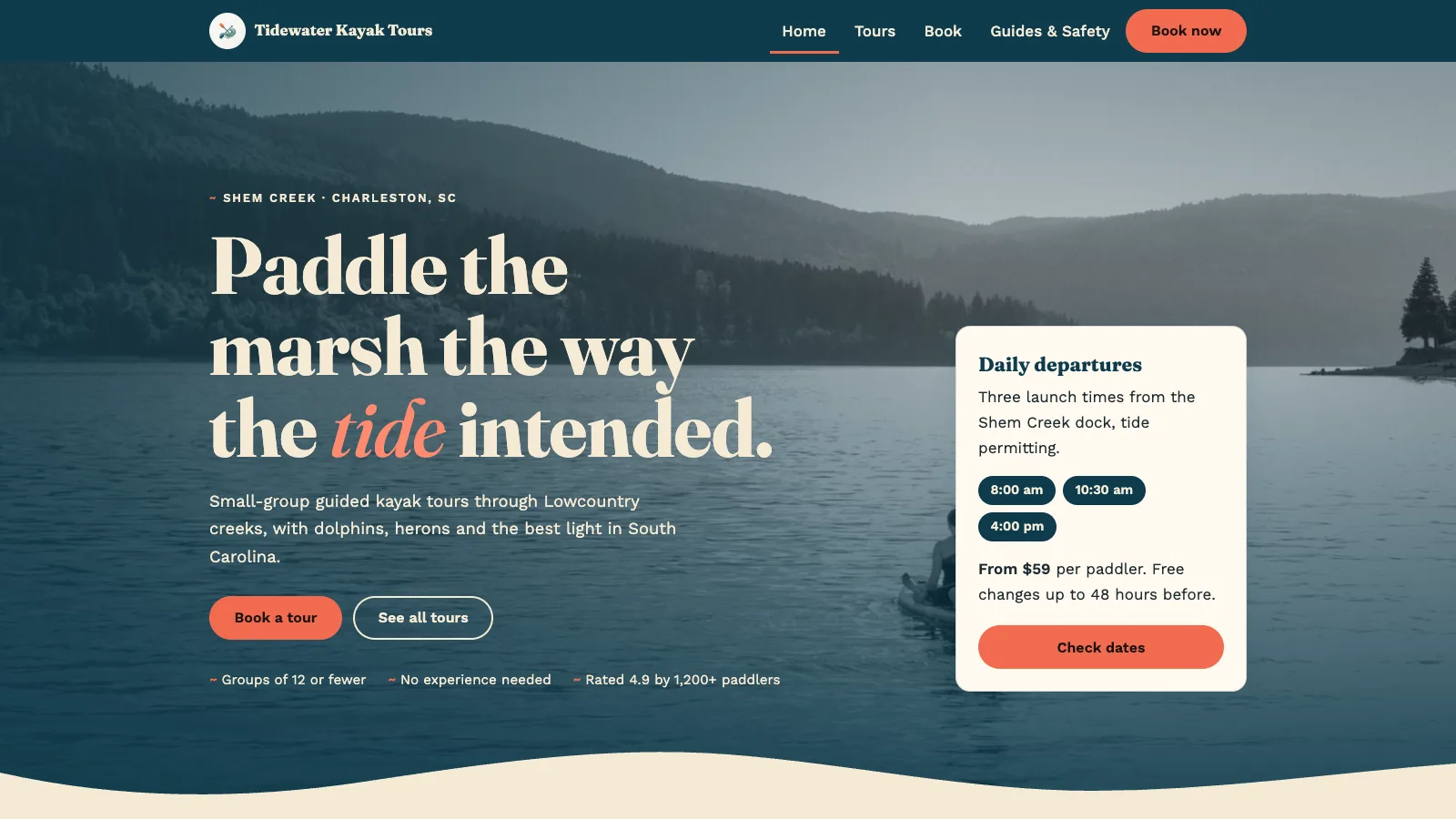
- With Supacode you can copy the free Tidewater booking template for 0 credits, reshape it by chatting and publish it to your own supacode.app address the same day.
- A real booking business still needs your own Supabase project for accounts and saved bookings, and a payment provider such as Stripe for money. Supacode writes the code; the accounts stay yours.
What are you really building when you build a site like Airbnb?
Every few weeks someone opens a blank document and types the same ambition: an Airbnb for surf camps, for treehouses, for dog sitters, for recording studios. The idea is easy to say. What sits underneath it is a two-sided marketplace: guests who search and pay, hosts who list and get paid, and a platform in the middle that holds the money, settles disputes and makes strangers trust each other.
The pages are the visible tenth of that iceberg. A listing grid, a photo gallery and a date picker can be built in an afternoon. The other nine tenths are rules: who may book which nights, what happens when two people press Book at the same second, when a host gets paid, how a refund works, and why anyone should believe the reviews.
This guide walks through both halves. First the architecture that real booking platforms run on, explained without jargon. Then the fastest honest route to a working version: a booking site you can click through, share and publish today with Supacode, an AI app builder that writes real HTML, React or Next.js code from a chat, followed by the steps that turn it into a business.
Do you need a booking website or a marketplace?
Answer this before you write a single prompt. A booking website sells one business's inventory: your guesthouse rooms, your kayak tours, your yoga classes. A marketplace sells other people's inventory and takes a cut. They look alike in a screenshot and are wildly different to run.
If you own the rooms or run the tours, you need the first. It is smaller, cheaper and can be live this week. If you want many independent hosts, you need the second, plus a plan for getting enough of them on board before guests arrive, because a marketplace with five listings is an empty shop.
- Who lists: a booking site has one operator; a marketplace has many hosts with their own accounts and dashboards.
- Who gets paid: a booking site is paid directly; a marketplace collects the money, keeps a fee and pays each host out, which needs a payments product built for platforms, such as Stripe Connect.
- What you moderate: a booking site writes its own listings; a marketplace reviews hosts, photos and reviews written by strangers.
- What it costs to start: a booking site can begin on a template and a free plan; a marketplace needs accounts, payouts, support and trust work before launch.
Which features does an Airbnb-style site need in version one?
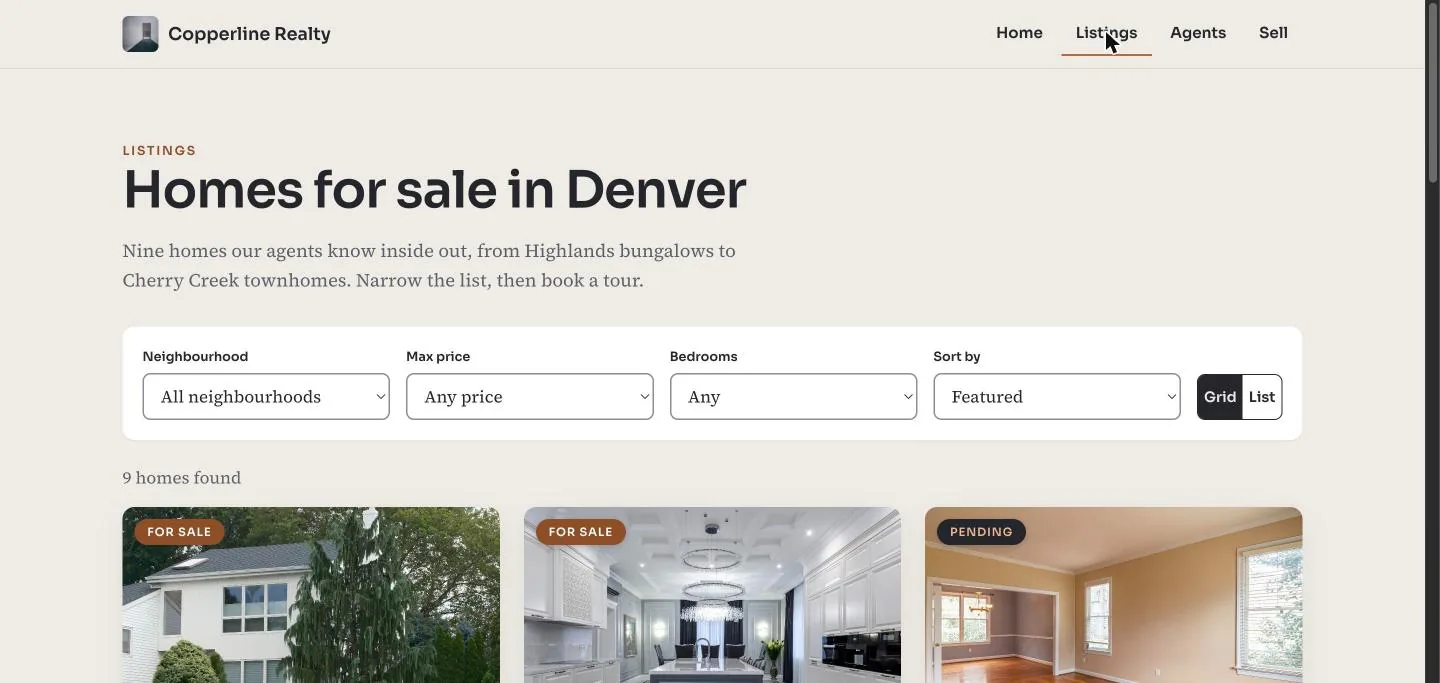
The temptation is to copy every Airbnb feature at once. Resist it. The first version only has to let one guest complete one booking without help. Everything else is a second release.
- Version one: search or a simple list, a listing page with photos and the price, a calendar that hides unavailable dates, a guest details form, a clear total with fees, a confirmation page and a confirmation email.
- Version one for the operator: a page that lists upcoming bookings and a way to block dates.
- Later: guest accounts and saved trips, reviews, messaging between guest and host, wish lists, coupons, multi-currency, instant book versus request to book, cancellation policies, payouts to many hosts.
- Much later: dynamic pricing, a mobile app, identity verification, smart-lock integrations.
How does a booking system work under the hood?
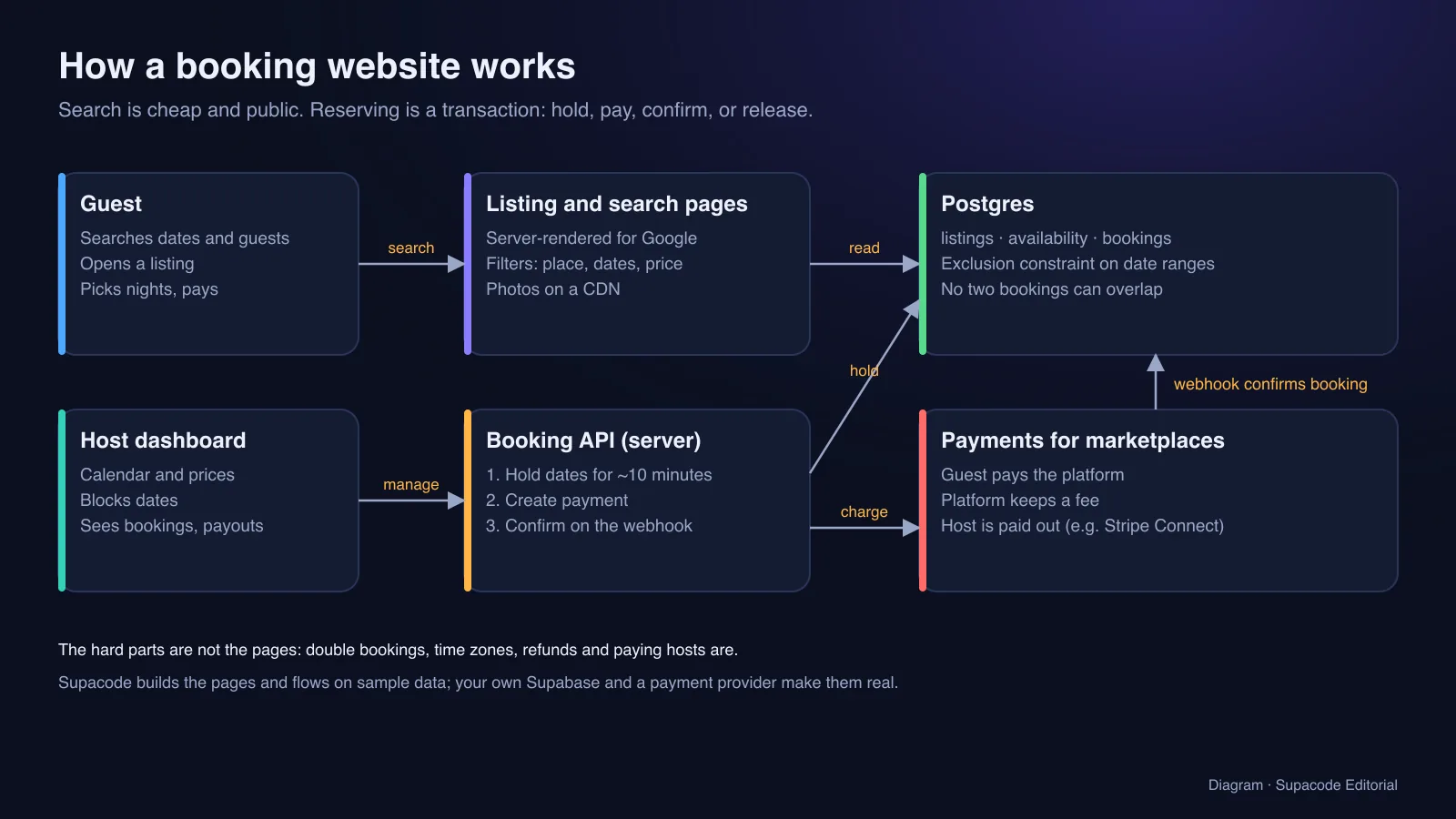
Search is the easy, public half. Listing and search pages should be rendered on the server so Google can read them, with photos served from a CDN. Filters for place, dates, guests and price are ordinary database queries until you have tens of thousands of listings.
Reserving is a transaction, and it is where amateur booking systems break. The reliable pattern has three moves. First, hold the dates for a few minutes while the guest pays. Second, create the payment. Third, confirm the booking only when the payment provider tells your server it succeeded, through a signed message called a webhook. If the payment fails or the hold expires, release the dates.
The database should refuse a double booking even if your code has a bug. Postgres can do this natively: store each stay as a date range and add an exclusion constraint so no two confirmed bookings for the same listing can overlap. Range types also make availability queries short and fast. Store check-in and check-out as calendar dates in the property's own time zone, not as moments in UTC, or a guest in Tokyo will eventually book the wrong night in Lisbon.
Money is the last layer. A single operator can take card payments with a hosted checkout. A marketplace needs to split each payment between the host and the platform and pay hosts on a schedule, which means identity checks for every host; platform products such as Stripe Connect exist to handle that. Maps are optional: the open-source Leaflet library with free tiles is enough for a few listings, while Google Maps Platform bills by usage.
How do you build a booking website with Supacode, step by step?
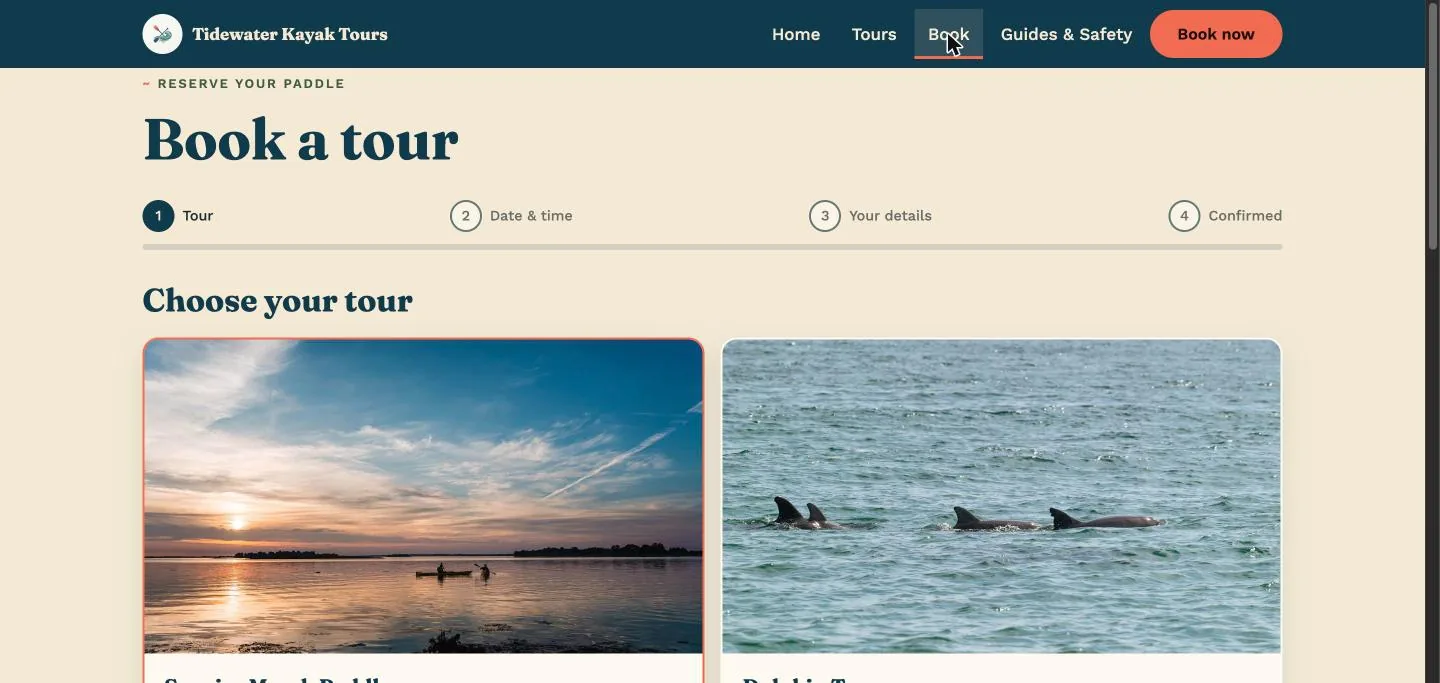
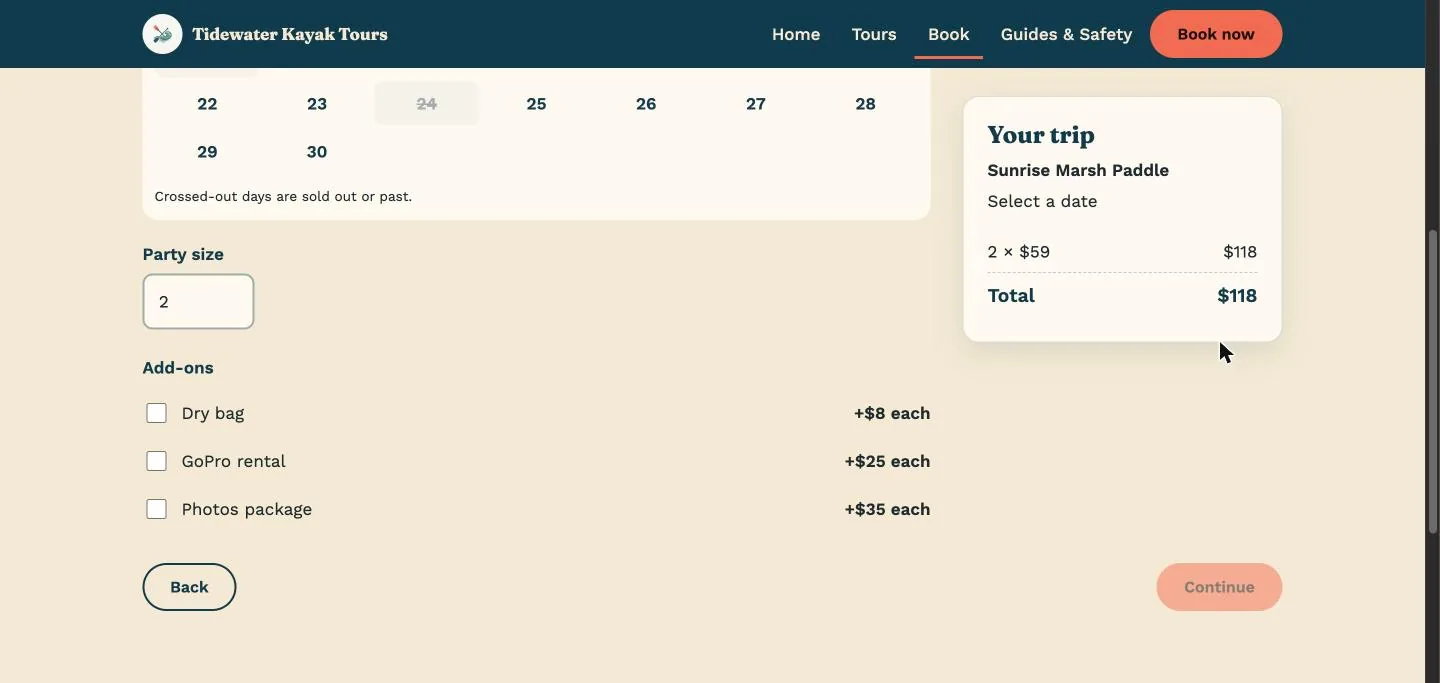
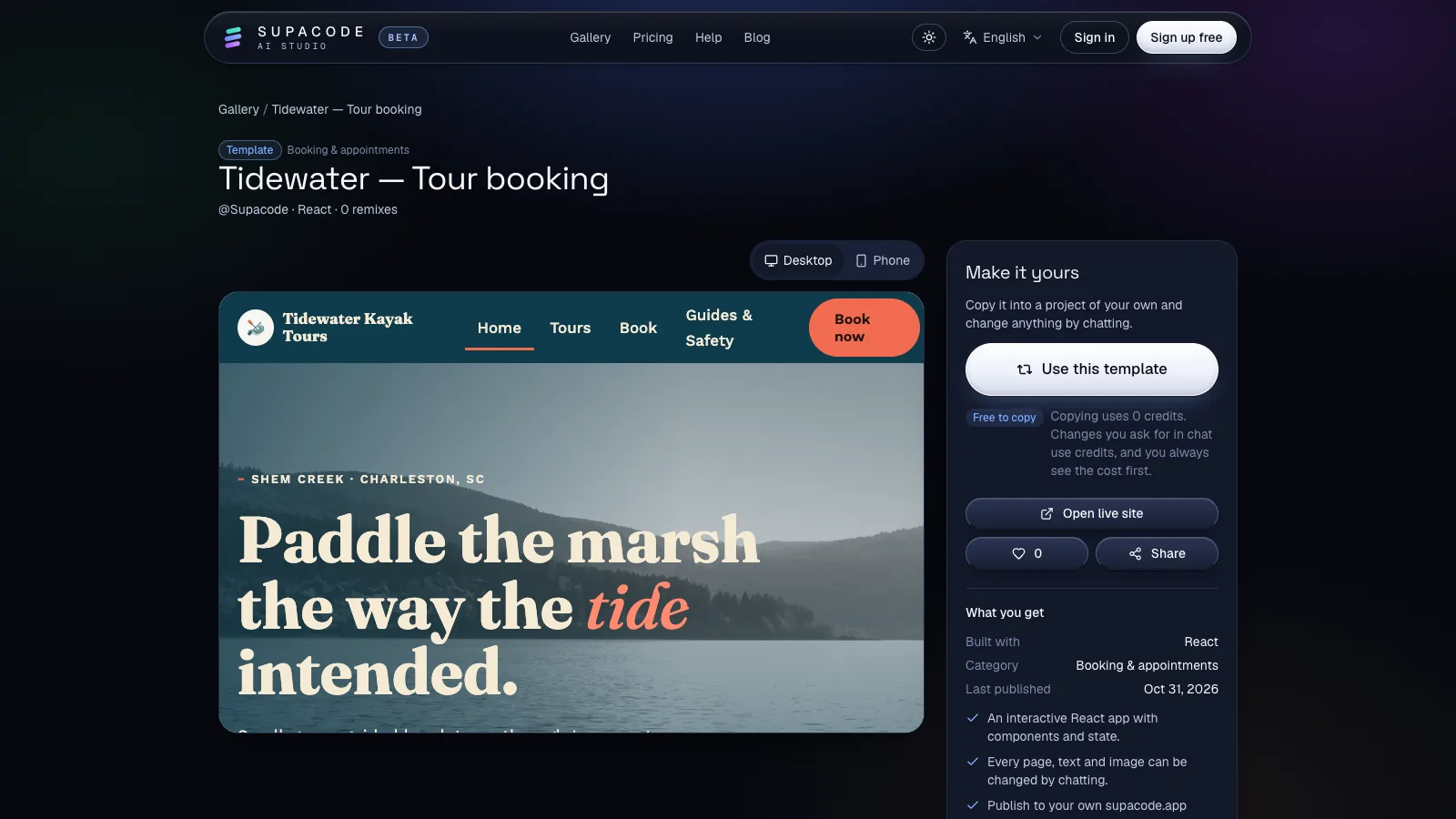
The quickest start is a template that already has the full path. Open the Tidewater tour-booking template in the gallery: a React app with tour cards, a month calendar where sold-out days are crossed out, party size, paid add-ons, a running total and a confirmation step. Press Use this template. Copying uses 0 credits and puts the project in your account, where every change after that is a chat message and the composer shows the credit estimate before anything runs.
Then describe your business. Each prompt below is one reviewable change; send them one at a time, check the live preview, and keep what works. Supacode saves a version after every change, so you can undo a step or restore an earlier version without losing history.
- Prompt 1, your inventory:
Turn this into a booking site for a 6-room guesthouse in Hoi An called Lantern House. Replace the tours with 3 room types (Garden, Balcony, Family suite), each with 4 photos, nightly price in USD, max guests and amenities. - Prompt 2, nights instead of time slots:
Change the date step to a check-in and check-out range picker. Show the number of nights, block dates that are already booked, require a 2-night minimum on Fridays and Saturdays, and update the total live. - Prompt 3, a clear price:
In the trip summary, show nightly price x nights, a cleaning fee of $15, 10% tax and the total. Add a cancellation note: free cancellation up to 7 days before check-in. - Prompt 4, the operator view:
Add an Admin page listing upcoming bookings by date with guest name, room, nights and total, and a way to block dates for maintenance. - Prompt 5, findability:
Give every room its own page with a unique title and meta description, and add an FAQ section about check-in, parking and breakfast.
How do you make the bookings real: accounts, database and payments?
Be clear about what a template is. Its booking flow runs in the browser: you can click through every step, but nothing is saved to a shared database, so a second visitor never sees the first visitor's booking. That is perfect for testing the experience and showing it to partners. It is not yet a booking system.
When Supacode builds a feature that needs a backend, such as sign-in or saved bookings, it typically builds the first version on sample data behind a single data file, then offers to connect a database. Connect your own Supabase project in the studio's Backend tab and ask for the switch: Supacode writes the tables and row-level security as a migration, uses Supabase Auth for sign-in, and runs nothing on your database until you approve it. The GitHub and Supabase guide shows the clicks. Your data lives in your Supabase project, not in Supacode.
Payments need a server. Ask for the booking flow in Next.js with an API route that creates the payment and a webhook route that confirms the booking. Static hosting cannot run those routes, so Supacode's Publish menu offers Deploy to connect your own Vercel account and host the app there; you add your payment keys in your Vercel project settings. If you plan to pay many hosts, design for Stripe Connect from the start.
- Prompt 6, real data:
Move bookings, rooms and blocked dates to my connected Supabase. Add a database rule so two bookings for the same room can never overlap, and require sign-in for the Admin page. - Prompt 7, payments:
Add Stripe Checkout: an API route that creates a checkout session for the booking total, and a webhook route that marks the booking confirmed when payment succeeds. Hold the dates for 15 minutes while the guest pays.
How much does it cost and how long does it take to build a site like Airbnb?
It depends far more on which of the two products you chose than on the tool. A single-operator booking site is a template and a few evenings. A marketplace is a company: the software is the smaller line item next to recruiting hosts, support, insurance questions and payments compliance.
On the software side, Supacode's Free plan gives 5 credits a day plus 20 welcome credits, copying a template costs nothing, and publishing to a supacode.app address is included. Paid plans add more credits, GitHub sync and AI image generation; the pricing page has current numbers. Outside Supacode, Supabase has a free tier (free projects pause after a week of inactivity, so move to a paid plan before launch), payment providers charge per transaction, and maps can be free with Leaflet or billed by usage.
- Booking site on a template: days, mostly spent on your photos, prices and policies.
- Booking site with your own database and card payments: one to a few weeks, including testing refunds and cancellations.
- Multi-host marketplace: months. Host onboarding, payouts, reviews, messaging, moderation and support each add real work, whatever builds the code.
Can you create a booking website for free?
Yes, for the front end and a first launch. Copy a booking template, change it with the daily free credits, and publish it on the Free plan to your own supacode.app address. Anyone with the link can open it, and it is only listed in the gallery if you choose to share it there.
Two honest limits apply. Your site lives on a supacode.app address, and a template's bookings are not stored anywhere until you connect a database. For a small business, a free first version that sends a booking request by email is often enough to test demand; switch to real bookings and payments when requests start arriving.
How do you get a travel or booking site found on Google?
Give every room, tour or listing its own page with a unique title, a description written for people, real photos with alt text and the price. Keep pages fast and readable on a phone. Plain HTML and Next.js pages are delivered as real HTML, which search engines read without running JavaScript; choose Next.js when you expect many listing pages.
Structured data helps, but read the fine print: Google's vacation rental markup is limited to sites that meet eligibility criteria and complete extra integration steps. For most small operators, clean pages, local business details, reviews and an FAQ do more. Our booking app use case covers the same ground for appointments.
What mistakes sink most Airbnb clones?
The failures are rarely about code. They are about trust and timing.
- Launching a marketplace with no supply. Sign up your first hosts by hand before you invite a single guest.
- Trusting the browser with availability or price. The server and the database decide; the page only displays.
- Ignoring the law. Many cities regulate short-term rentals, taxes and guest registration; check the rules where your listings are.
- Treating reviews as decoration. Reviews are the product. Only let guests with a completed stay leave one.
- Copying Airbnb's brand. Build your own name and look; a specific niche with a clear promise beats a generic clone.
FAQ
Frequently asked questions
How much does it cost to build a website like Airbnb?
A single-operator booking site can start free on a template and a free plan, plus payment fees per booking. A multi-host marketplace costs far more because of payouts, support, moderation and host acquisition, whatever tool writes the code. See pricing for Supacode's plans.
Can I build an Airbnb clone without coding?
You can build and publish a working booking site by describing it in Supacode's chat, starting from a template. Turning it into a real marketplace still requires decisions about your database, payments and policies, and Supacode writes real code you or a developer can review.
How do I prevent double bookings?
Let the database enforce it. Store each stay as a date range and use a Postgres exclusion constraint so overlapping bookings for the same listing are rejected, hold dates briefly during payment, and confirm only on the payment webhook.
Can I create a booking website for free?
Yes. Copy a booking template for 0 credits, edit it with the Free plan's daily credits and publish it on a supacode.app address. Saved bookings need a database such as your own Supabase project.
Do I need a mobile app to compete with Airbnb?
Not at the start. A fast, responsive website works on every phone and can be found on Google. Supacode builds web apps, not App Store apps; consider a native app once repeat guests ask for one.
Should I use HTML, React or Next.js for a booking site?
HTML for a simple site that sends booking requests, React for a rich interactive booking flow, and Next.js when you need sign-in, a database, payment routes and many indexable listing pages.
Sources
- Exclusion constraints · PostgreSQL documentation
- Range types · PostgreSQL documentation
- Stripe Connect · Stripe documentation
- Receive Stripe events in your webhook endpoint · Stripe documentation
- Vacation rental structured data · Google Search Central
- Google Maps Platform pricing · Google
- Leaflet · Leaflet
- Supabase pricing · Supabase