How to build a dating app like Tinder, from scratch or AI
How Tinder-style apps work: profiles, the swipe deck, mutual matches, chat and safety rules. Then build a dating app with AI in Supacode, prompt by prompt.

By Supacode Editorial · Product and engineering
Contents
Quick answer
- A dating app like Tinder runs on three loops: a deck of nearby profiles that fit both people's preferences, a swipe that becomes a match only when both people like each other, and a private chat that opens after the match.
- The technology is approachable; the hard parts are getting enough people in one place to make the deck worth opening, and keeping them safe: reporting, blocking, moderation and age checks are required by the app stores, not optional.
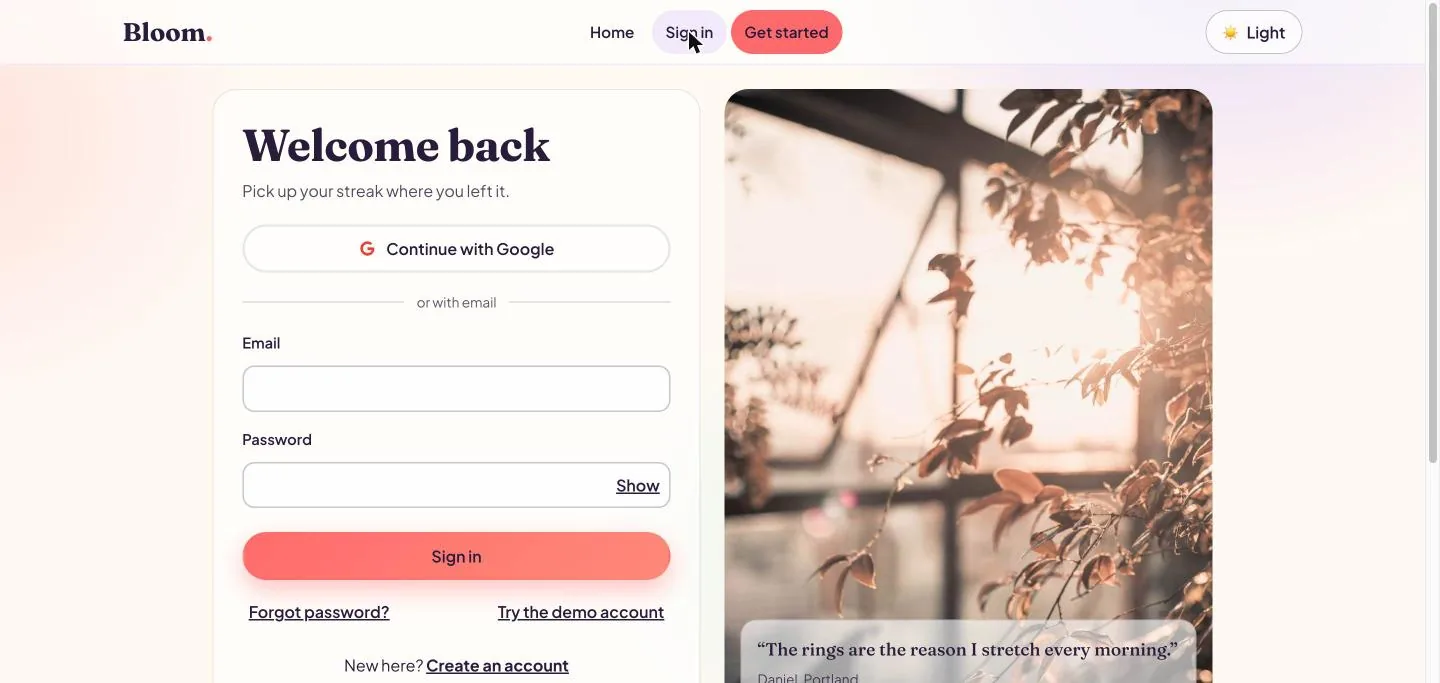
- With Supacode you can build a working dating web app by describing it in the chat or remixing the Bloom sign-in template, then connect your own Supabase project for real accounts, photos, matches and messages.
- Supacode builds web apps that run in any phone browser; it does not produce App Store or Google Play apps.
What are you really building when you build an app like Tinder?
A person opens an app on a train, looks at a face and a sentence, and decides in under a second. Multiply that by millions of people and you have a pattern that has shaped a decade of consumer apps. Pew Research Center found that three in ten U.S. adults have used a dating site or app.
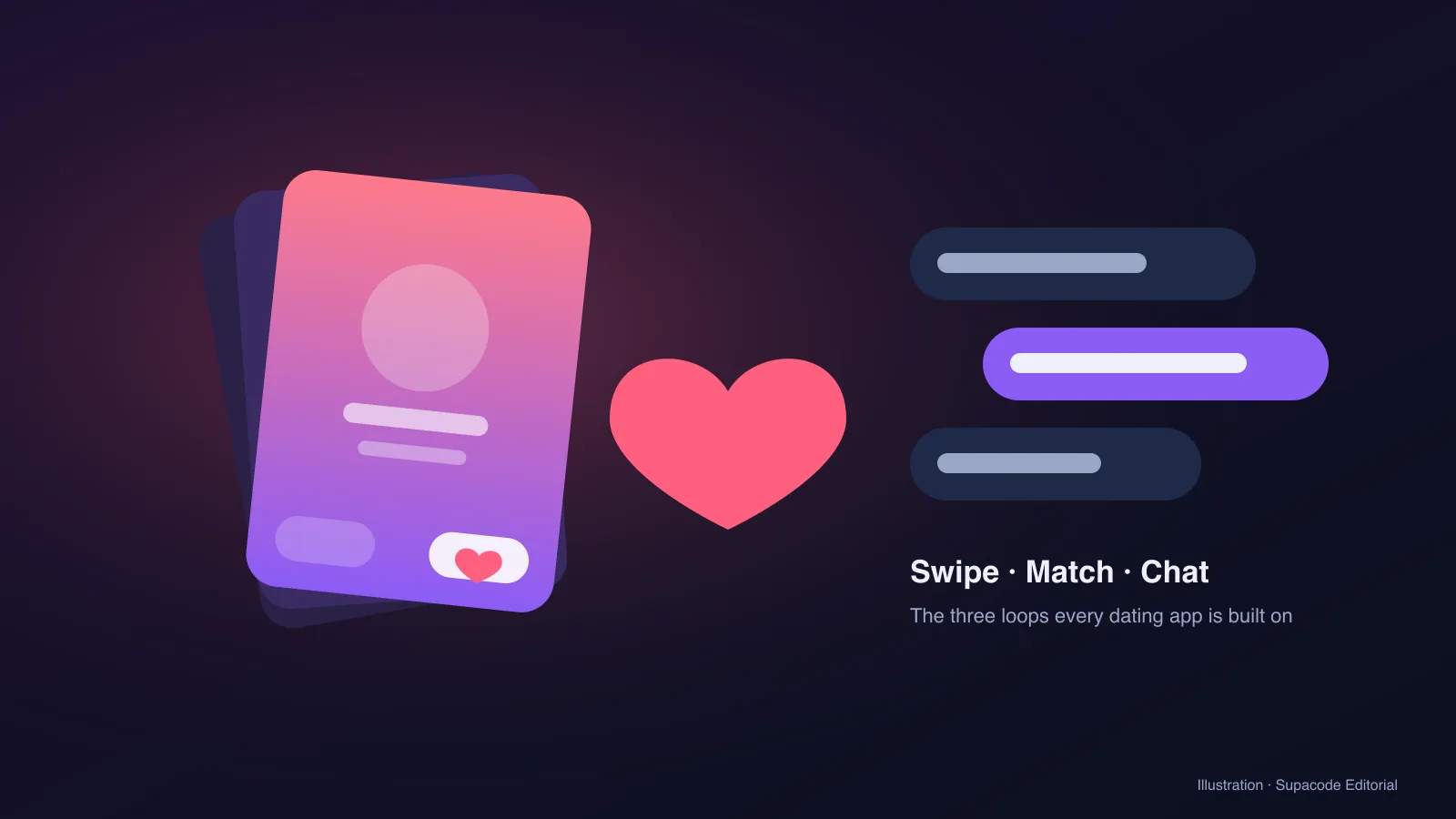
Strip away the brand and a Tinder-style app is three loops. Discovery shows a deck of profiles near you that match what you want and who want someone like you. Matching turns two independent likes into a connection. Conversation opens a private chat that only the two of you can read. Around those loops runs a fourth that users never see until it fails: safety.
This guide explains how each loop works, why the business problem is harder than the code, and how to build a working version with Supacode, an AI app builder that writes real React or Next.js code from a chat.
Why do new dating apps start with a niche?
A dating app is a marketplace in which every user is both buyer and product. Its value depends on density: enough compatible, active people within reach of each other. An empty deck on day one is the most common way these apps die.
That is why successful newcomers start narrow: one city, one community, one intent. A dating app for climbers in Denver, for Korean-speaking professionals in Sydney, or for people over fifty who want something serious can feel full with a few hundred members, where a general app would feel empty with a few thousand. Launch with an event, a waitlist and a date when the deck opens, so everyone arrives at once.
Which features does a dating app need in its first version?
Build the smallest app that lets two real people match and talk safely. Everything that sells subscriptions can wait.
- Accounts: sign-up with email or a social login, an 18+ age gate, and delete my account.
- Profiles: three to six photos, a short bio, two or three prompts, age, rough location, what you are looking for.
- Preferences: distance, age range and who you want to see.
- The deck: one card at a time with like and pass, buttons as well as gestures for accessibility.
- Matches and chat: a match screen, a list of matches, and one-to-one messages.
- Safety: report, block, unmatch, and a way to contact you, from the first release.
- Later: boosts, super likes, subscriptions, video calls, photo verification, events.
How does Tinder-style matching work under the hood?
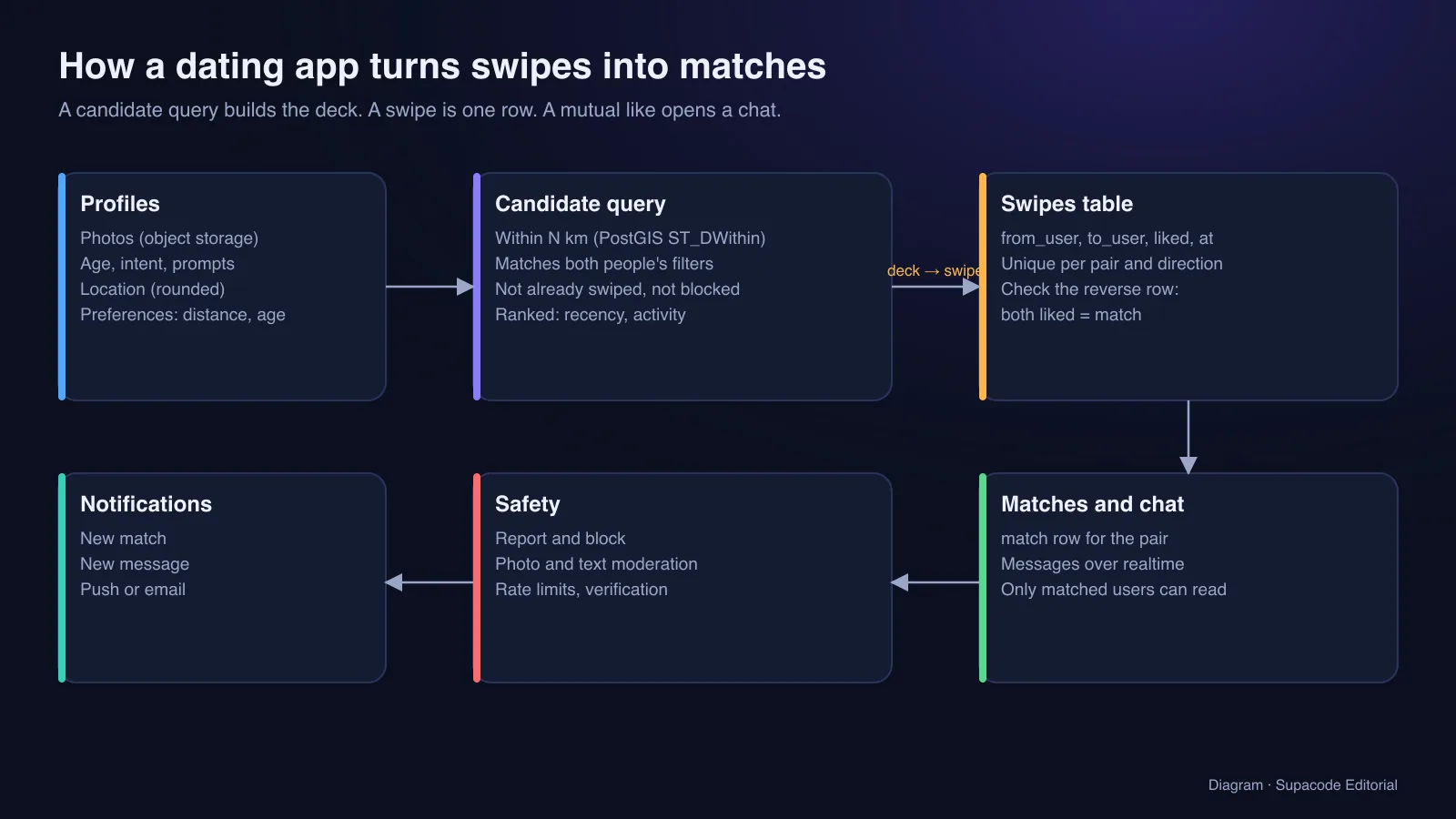
The deck is a database query. Find people within the distance you chose, whose age and gender fit your preferences and whose preferences fit you, whom you have not already swiped and who have not blocked you, then order them by something sensible such as recent activity. In Postgres, the PostGIS function ST_DWithin answers the within N kilometres part efficiently with a spatial index.
A swipe is one row: who, whom, like or pass, and when, with a unique constraint so each person can swipe each other person once. When a like arrives, check whether the reverse like already exists; if it does, create a match row for the pair in the same transaction and notify both people. That check belongs in the database or on the server, never in the browser.
Two privacy details separate careful apps from careless ones. Round stored locations and show distance in coarse steps, because exact distances can be combined from several points to find someone's home. And never send the deck data for people a user is not allowed to see: filter on the server, not by hiding cards in the interface.
How do matches chat in real time?
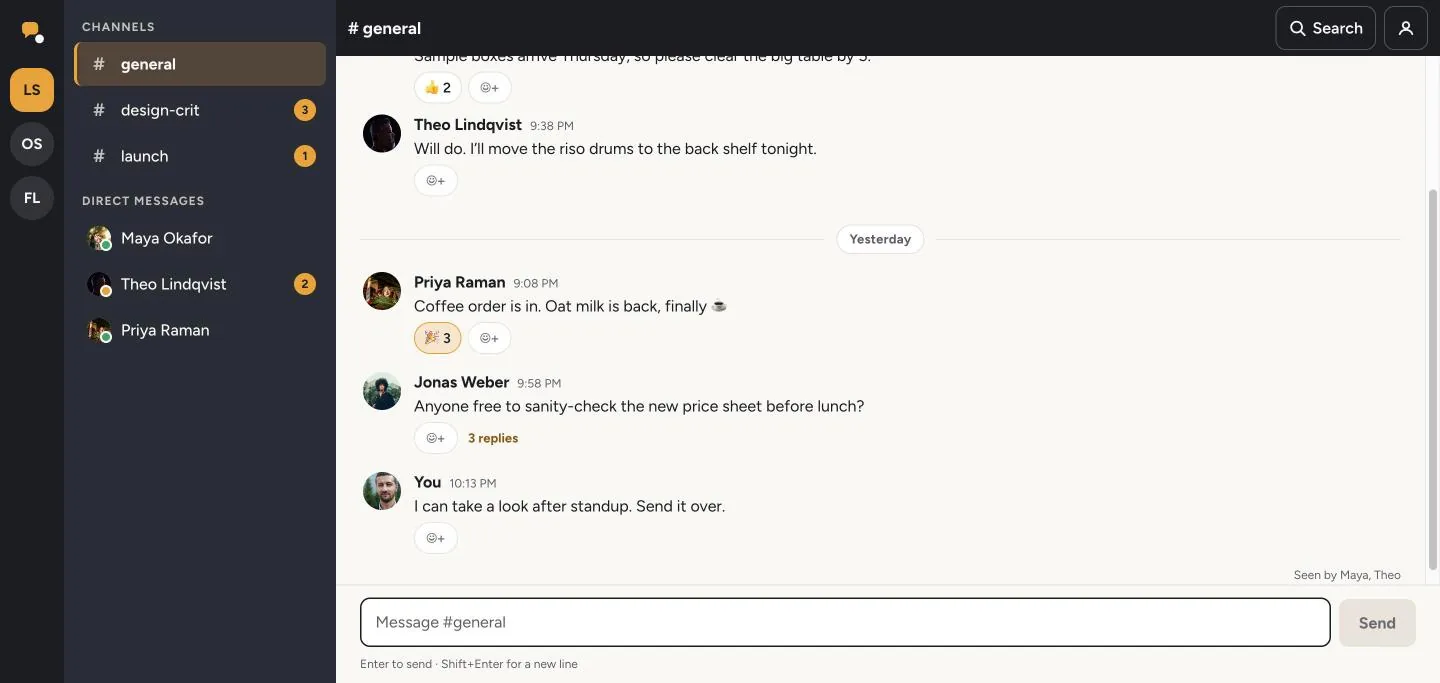
Messages are rows in a messages table tied to a match. The rule that matters is who may read them: only the two people in that match. Enforce it with row-level security, so even a buggy screen cannot show someone else's conversation. New messages reach the other phone through a realtime subscription, which Supabase Realtime provides, and a push or email notification covers the moments the app is closed.
Add read receipts, typing indicators and photo messages later. Add a message rate limit and a link and phone-number filter early, because scammers move fast.
What safety features does a dating app need?
Safety is not a feature you add after launch; it is a condition for launching. Apple's App Review Guidelines require apps with user-generated content to include a way to filter objectionable material, a way to report offensive content with timely responses, the ability to block abusive users, and published contact information. Google Play has a comparable user-generated content policy. Even as a web app, build to that standard.
- Report and block on every profile and in every chat, with a moderation queue you actually review.
- Automated checks on photos and bios before they appear, and limits on new accounts' likes and messages.
- An 18+ age requirement in your terms and sign-up, and a plan for verification as you grow.
- Safety tips in the app: meet in public, tell a friend, never send money.
- A real delete: when someone leaves, their photos, messages and location go too.
How do you build a dating app with AI in Supacode, step by step?
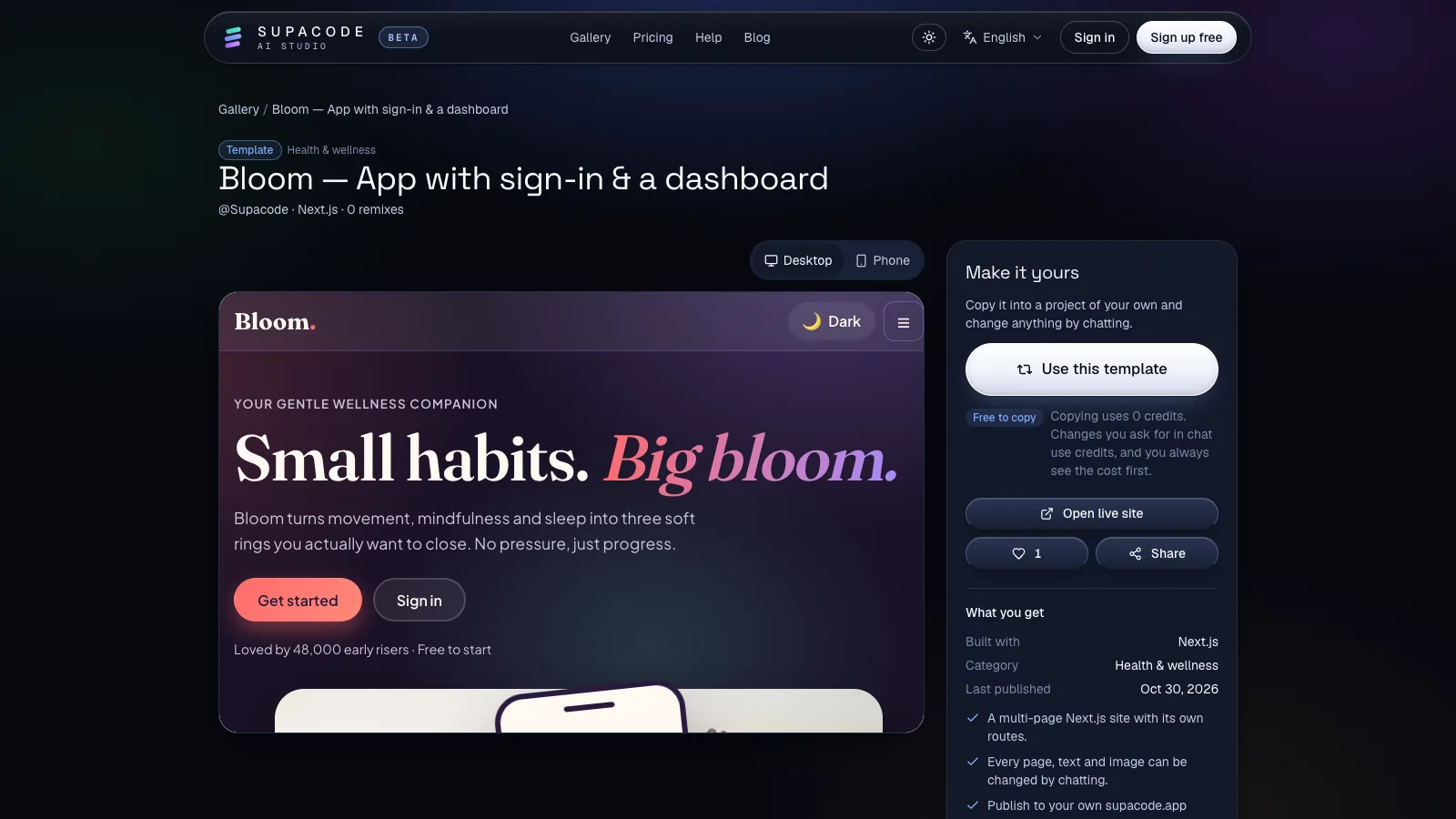
There is no dating template in the gallery yet, so you have two good starts. Describe the app from scratch in the composer on the home page, or remix Bloom, a Next.js template with a landing page, sign-in and sign-up screens with a demo account, and a dashboard, and turn it into a dating app. For the chat look, Parley is a useful reference. Copying a template uses 0 credits, and every change shows its credit estimate before it runs.
Build one loop at a time and test it in the live preview. Supacode saves a version after every change, so you can undo a step or restore any earlier version.
- Prompt 1, the idea:
Build a mobile-first dating web app called Belay for climbers in Denver. Screens: welcome, sign up, profile setup with 4 photos, bio, 3 prompts, climbing grade and preferences, a swipe deck, matches and chat. Use Next.js. - Prompt 2, the deck:
Make the deck one card at a time with photo carousel, name, age, distance rounded to the nearest 5 km and prompts. Support swipe gestures and Like and Pass buttons, and show an empty state when no profiles are left. - Prompt 3, matching:
When two people like each other, show a match screen with both photos and a Send a message button, and add the match to a Matches list with the last message preview. - Prompt 4, chat:
Build the chat screen for a match: messages grouped by day, timestamps, a typing area, and a menu with Unmatch, Block and Report. - Prompt 5, safety:
Add a Report dialog with reasons, a Safety tips page, and an Admin page listing reports with buttons to dismiss, warn or ban.
How do you make accounts, photos, matches and messages real?
A first build runs on sample profiles, which is ideal for testing the experience with friends. When a request needs a backend, Supacode typically builds on sample data first and then offers to connect a database. Connect your own Supabase project in the studio's Backend tab: Supacode writes the tables and row-level security as a migration, uses Supabase Auth for sign-in, and runs nothing on your database until you approve it; see Connect GitHub and Supabase. Ask for profile photos to be stored in a private Supabase Storage bucket rather than the database.
Server work such as calling a moderation service runs as Next.js API routes, which need a server: deploy to your own Vercel account from the Publish menu. Supacode builds web apps; if you want an icon on the home screen, you can ask for an installable web app (a progressive web app, or PWA), but it is still not an App Store app.
- Prompt 6, real data:
Use my connected Supabase for profiles, photos, swipes, matches and messages. Row-level security: people read profiles only through the deck query, and only the two people in a match can read its messages. Create a match automatically when likes are mutual. - Prompt 7, distance:
Store each profile's location rounded to about 1 km and use a PostGIS distance query for the deck, filtering by both people's age and distance preferences on the server.
How much does it cost and how long does it take to build a dating app?
The code for the three loops is a few weeks of focused work for a small team and less with an AI builder. The real budget goes to getting members (events, ads and community partners), moderation hours, and, if you go native, two app-store releases. Plan moderation as a daily cost from the first week.
On Supacode, the Free plan gives 5 credits a day plus 20 welcome credits, and publishing to a supacode.app address is included; pricing lists paid plans. Supabase has a free tier for small projects, and its free projects pause after a week of inactivity, so move to a paid plan before launch.
- Clickable prototype on sample profiles: a day or two.
- Web app with real accounts, photos, matching and chat on your own Supabase: two to a few weeks, most of it testing privacy rules.
- Native apps, verification, subscriptions and a moderation team: months.
FAQ
Frequently asked questions
How do I build a dating app from scratch?
Model profiles, preferences, swipes, matches and messages; build the deck as a server-side query with distance and mutual preferences; create a match when two likes meet; secure chat with row-level security; and ship report and block before launch.
Can I build a dating app with AI?
Yes. In Supacode you describe the app or remix a template such as Bloom, refine it by chatting, and connect your own Supabase project for real accounts, photos, matches and messages. You still own the safety rules and moderation.
How does the Tinder matching algorithm work?
At its core: a candidate query filters nearby people who fit both users' preferences and have not been swiped or blocked, then ranks them; a match is created only when both people like each other. Large apps add more ranking signals and split their data by geography to stay fast.
How much does it cost to build an app like Tinder?
A working web version can start on free tiers. The larger costs are attracting members in one area, daily moderation, verification and, for native apps, separate iOS and Android development.
Can I build a dating app for free?
You can build and publish a prototype free on Supacode's Free plan, which gives 5 credits a day plus 20 welcome credits, and use Supabase's free tier for a small test group.
Does Supacode make iOS and Android dating apps?
No. Supacode builds web apps that run in any phone browser and publish in one click. You can ask for an installable web app, but App Store and Google Play apps need native development.
Sources
- From looking for love to swiping the field: online dating in the U.S. · Pew Research Center, 2023
- ST_DWithin · PostGIS documentation
- Row level security · Supabase documentation
- Supabase Realtime · Supabase documentation
- App Review Guidelines · Apple Developer
- User-generated content policy · Google Play Console Help
- Progressive web apps · MDN Web Docs